Not legal advice. This page summarizes FCC rules (47 CFR Part 95) from the official sources linked in the text. Rules and fees checked . The FCC sets its fees annually and can change its rules, so confirm the current version on fcc.gov before you rely on it.
The contenders
Side by side
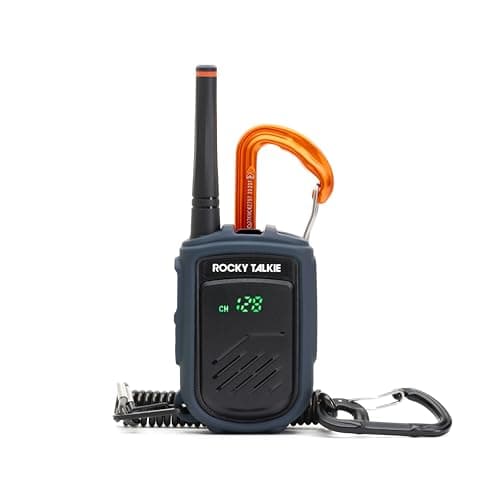
Rocky Talkie, license-free
Rocky Talkie Mountain Radio (single radio)
6.1 oz, IP56, shatterproof screen, a climbing-rated carabiner with a metal-reinforced leash, and a replaceable pack rated 3 to 5 days. No NOAA weather channel.
$120.00Amazon#ad · Price as of November 2, 2026 · How we make money for the link to Rocky Talkie Mountain Radio (single radio)
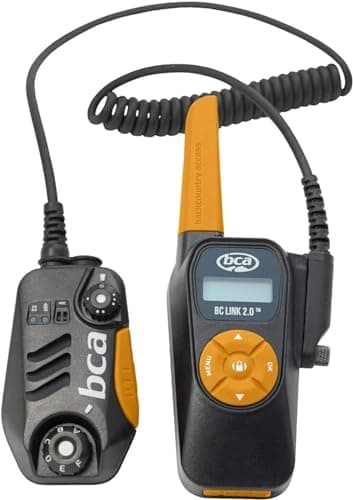
BCA, two-piece
BCA BC Link 2.0 Radio (NA Edition)
The base unit and its 2300 mAh battery ride inside your pack while the Smart Mic clips to a strap. NOAA channels and presets, but 11 oz, a sealed battery and Micro-USB.
$150.76Amazon#ad · Price as of November 2, 2026 · How we make money for the link to BCA BC Link 2.0 Radio (NA Edition)
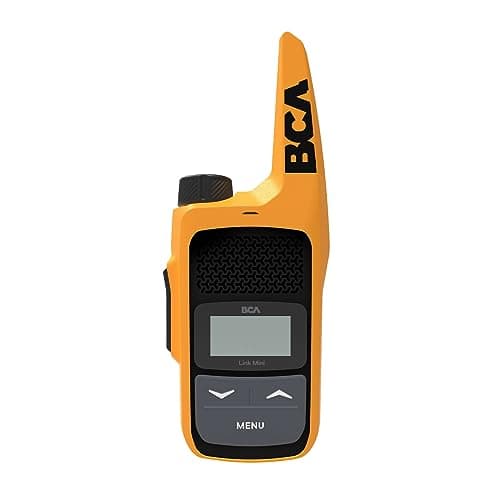
BCA, one-piece
BCA BC Link Mini Radio (NA Edition)
6 oz, IP55, USB-C and dual-channel scanning, with webbing clips, a Velcro strap, a belt clip and a leash in the box. No NOAA channel listed.
$119.95Amazon#ad · Price as of November 2, 2026 · How we make money for the link to BCA BC Link Mini Radio (NA Edition)
Rocky Talkie, licensed
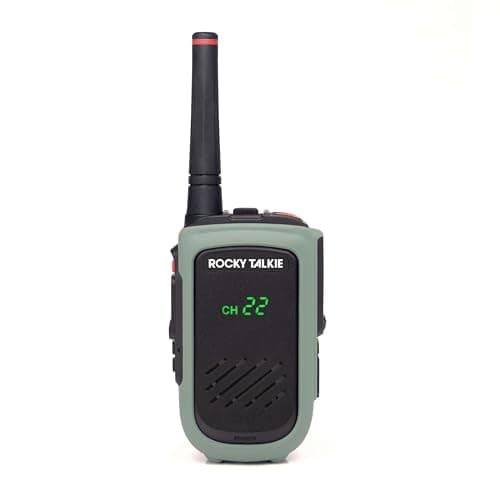
Rocky Talkie Expedition Radio (single radio)
The only radio here that leaves FRS behind: 5 W GMRS, 8 repeater channels, a removable antenna and IP67, with a GMRS license required per operator household.
$195.00Amazon#ad · Price as of November 2, 2026 · How we make money for the link to Rocky Talkie Expedition Radio (single radio)
Rocky Talkie and Backcountry Access are the two brands that actually built radios for people who go uphill. Everything else in the category is a consumer walkie-talkie that happens to get taken outside. Both companies charge real money, both ship leashes instead of belt clips, and both are sold in the same shops to the same buyer — which is why "Rocky Talkie vs BCA" is one of the most-searched radio comparisons there is.
They disagree on something basic, though: where a radio should be. BCA's BC Link 2.0 is a two-piece system, with the radio and its battery inside your pack and a Smart Mic clipped to a shoulder strap. Rocky Talkie builds a single hard-cased handheld you clip to a strap or a harness with a carabiner. The BC Link Mini splits the difference and is BCA's answer to the Rocky Talkie directly.
This page compares all four radios on nothing but what the two makers publish, read on the dates in the sources below. We do not test radios, and we say so on how we rank. That is enough to settle the comparison, because one of these brands is considerably more careful with its numbers than the other.
The short version
- Ergonomics: BCA wins if you ski with a pack on. The Smart Mic puts push-to-talk at your collarbone and keeps the battery in a warm pocket of your pack.
- Hardware honesty: Rocky Talkie wins outright. It publishes a replaceable battery, a climbing-rated carabiner, a shatterproof screen, and for the Expedition a removable antenna — all things BCA does not claim.
- Range claims: Rocky Talkie wins. It prints mountains, forest, rivers and city figures separately. BCA prints two numbers that contradict each other on the same product.
- Weight: a tie at the light end — BC Link Mini 6 oz, Rocky Talkie Mountain 6.1 oz — and a clear loss for the two-piece BC Link 2.0 at 11 oz.
- Weather alerts: BCA wins on the BC Link 2.0, which lists 11 NOAA weather channels. Neither the Mini nor the Rocky Talkie Mountain lists a weather receiver; the Expedition does.
- Reach: the Rocky Talkie Expedition wins, because it is the only one of the four that is not an FRS radio.
Where the radio lives, and why it is the real decision
BCA's argument is that a radio is unusable if you have to take a pack off to reach it. So the BC Link 2.0 is two pieces: a base unit with the battery that drops into a pack pocket, and a Smart Mic on a cable that clips to a shoulder strap or jacket, carrying the controls (BC Link 2.0 page). On a touring day with gloves, goggles and a pack you never remove, that is a real advantage, and it is why the design has lasted through three generations.
It costs you three things. It is 11 oz, nearly double the Mini and the Rocky Talkie Mountain. It is a cable across your chest, which is one more thing to snag and one more connector to fail. And the battery is not removable, charged over Micro-USB.
Rocky Talkie's argument is the opposite: make the radio small and hard enough that it can live outside on a strap. The Mountain Radio is 6.1 oz with a 7.5 cm antenna, a shatterproof screen, and a climbing-rated Trango Quantum carabiner plus a metal-reinforced back-up leash in the box (Mountain Radio page). On a harness, at a belay, or clipped to a sled bag, that is the better answer, and it is what the two designs are really arguing about.
The BC Link Mini is BCA conceding the point. It is a one-piece 6 oz radio, IP55, USB-C, and it ships with two webbing clips, a Velcro strap, a belt clip and a carabiner leash so you can mount it however you like (BC Link Mini page). It also keeps one feature neither Rocky Talkie offers: dual-channel scanning across two presets, so you can watch a group channel and a second channel at once.
The range claims, side by side — and the one that falls apart
All four radios are limited by the same physics and, for three of them, the same rules. FRS is capped at 2 W on channels 1 to 7 and 15 to 22 and 0.5 W on 8 to 14 (47 CFR 95.567), with a permanently attached antenna (47 CFR 95.587). So the interesting question is not which brand reaches farther — on FRS, broadly neither — but which brand tells you the truth about it.
Rocky Talkie publishes a terrain table. For the Mountain Radio: 35-plus miles line of sight, 1 to 5 miles in mountains, 0.5 to 3 miles in forest and hills, up to 1 mile in a city. For the Expedition: 2 to 8 miles in mountains, 0.5 to 5 in forest and hills, 0.5 to 3 along rivers, up to 1.5 in a city. That is a maker telling you the box number is the box number and here is what you will actually get.
BCA contradicts itself on both radios. The BC Link 2.0 product page advertises terrain range of 0.5 to 6 miles and line of sight "up to 40 mi"; its own owner's manual says "approximately 6 miles line of sight" (BC Link 2.0 manual). The Mini's page advertises line of sight "up to 32 mi", while BCA's own FAQ says "all BC Link radio models can transmit at a range of up to 6 miles" with optimal line of sight (BC Link FAQ). Those are not rounding differences; they are different claims by a factor of five or more.
Batteries and charging: the clearest win on the page
This is where the comparison stops being close.
- Rocky Talkie Mountain: a replaceable 1550 mAh Li-ion pack, USB-C, with Rocky Talkie's own figure of 3 to 5 days.
- Rocky Talkie Expedition: a replaceable 7.4 V 1800 mAh pack, USB-C, 4 to 6 days (Expedition Radio page).
- BC Link 2.0: an integrated 2300 mAh pack that is not removable, charged over Micro-USB, with BCA quoting "8 hours of normal use and maximum of 40 hours".
- BC Link Mini: a 1800 mAh battery on USB-C, BCA quoting a maximum of 33 hours, with no replacement pack listed.
Two things follow. On a hut trip or a multi-day hunt, a swappable pack is the difference between a working radio on day four and a brick — and only Rocky Talkie offers one. And in 2026, Micro-USB on the BC Link 2.0 means carrying a cable you otherwise stopped carrying years ago. BCA's bigger battery is a genuine counter-argument for a single long day, especially with the base unit kept warm inside a pack, which is the one place the two-piece design helps the battery as well as the ergonomics.
Water, weight and retention
Published water ratings, maker's own words: Rocky Talkie Expedition IP67 (1 meter submersion); Rocky Talkie Mountain and BC Link 2.0 IP56; BC Link Mini IP55, which BCA pairs with a note that it should not be fully submerged. For snow, that spread barely matters. For a creek crossing or a kayak, the Expedition is the only one of the four designed to survive a dunk.
Weight: BC Link Mini 6 oz, Rocky Talkie Mountain 6.1 oz, Rocky Talkie Expedition 9.1 oz, BC Link 2.0 11 oz.
Retention is the underrated row. All four ship something better than a bare belt clip, which already puts them ahead of the consumer category, but the specifics differ: Rocky Talkie ships a climbing-rated carabiner and a metal-reinforced back-up leash with the Mountain Radio, and BCA ships the Mini with webbing clips, a Velcro strap, a belt clip and a leash. The BC Link 2.0's retention is the pack it lives in.
Every published spec, side by side
The license question, which only matters for one of them
Three of these four radios are FRS: the Rocky Talkie Mountain, the BC Link 2.0 and the BC Link Mini. FRS is licensed by rule, so anybody may use one, at any age, with no application and no fee (FCC: Family Radio Service). For a group of friends or a client group, that is the whole appeal, and it is why BCA built its line on FRS.
The Rocky Talkie Expedition is GMRS, and GMRS needs an individual FCC license. The license runs ten years, carries a fee set on the FCC's fee schedule (FCC application fees), needs no exam, and covers the holder plus their immediate family — spouse, children, parents, grandparents, siblings, in-laws and so on (47 CFR 95.1705). It does not cover a ski partner, a client or a coworker. GMRS operators also have to identify with their call sign (47 CFR 95.1751).
What the license buys on the Expedition is real: 5 W instead of 2 W, a removable antenna, and 8 repeater channels, which is the only way any of these radios reaches across a range rather than a valley. The whole decision is laid out in do you need a GMRS license?
Who should buy which
- Ski touring with a pack you never take off: BC Link 2.0. The Smart Mic on your strap is the right ergonomic and the warm pack pocket helps the battery. Accept the weight and the Micro-USB.
- Resort skiing, sledding, or a lighter touring kit: BC Link Mini or Rocky Talkie Mountain. Near-identical weight; pick the Mini for dual-channel scanning and mounting options, the Rocky Talkie for the replaceable battery, the better water rating and the carabiner.
- Climbing, canyons and anything on a harness: Rocky Talkie Mountain. The carabiner, the leash and the shatterproof screen are the reason.
- Multi-day trips, cold camps and hunting: Rocky Talkie, for the swappable pack. If the party is family and you want repeater access and 5 W, the Expedition.
- A mixed group where nobody holds a license: any of the three FRS radios here. Our license-free picks cover the cheaper end of that question.
- You want weather alerts in the radio: BC Link 2.0 or Rocky Talkie Expedition. The Mini and the Mountain Radio do not list a weather receiver — see radios with NOAA weather alerts.
If you are still choosing between the two Rocky Talkies rather than between the brands, that is a separate head-to-head: Rocky Talkie Mountain Radio vs Expedition Radio. And if durability is the thing driving the purchase, the whole category is ranked on published durability facts in the most rugged walkie-talkies.
In detail
The contenders, in full
Rocky Talkie, license-free
Rocky Talkie Mountain Radio (single radio)
6.1 oz, IP56, shatterproof screen, a climbing-rated carabiner with a metal-reinforced leash, and a replaceable pack rated 3 to 5 days. No NOAA weather channel.
Published specsResearched · every figure sourced
How the 6.7 score breaks down
- Real-world reach (30%)
- 5
- Ease of use (20%)
- 9
- Toughness & weather (15%)
- 8
- Power & battery (15%)
- 8
- Field features (10%)
- 4
- Value (10%)
- 6
What the specs support
- Publishes honest terrain figures (1 to 5 miles in mountains), not just a box number
- IP56, shatterproof screen and a real climbing carabiner with a leash
- Replaceable Li-ion rated for 3 to 5 days, with USB-C
- Channel lock keeps a group from drifting off channel
Where it falls short
- Sold as a single radio, so a pair costs twice the listed tier
- No NOAA weather channel or VOX
- Fixed antenna and FRS power limit its reach like any FRS radio
Skip this if…
…Skip it if you need to reach a partner several ridges away or hit a repeater: at 2 W FRS with a fixed antenna, the GMRS Expedition Radio is the Rocky Talkie for that.
#ad · Price as of November 2, 2026 · How we make money for the link to Rocky Talkie Mountain Radio (single radio)
BCA, two-piece
BCA BC Link 2.0 Radio (NA Edition)
The base unit and its 2300 mAh battery ride inside your pack while the Smart Mic clips to a strap. NOAA channels and presets, but 11 oz, a sealed battery and Micro-USB.
Published specsResearched · every figure sourced
| Service & power | FRS; 2 W, with FRS channels 8 to 14 at 0.5 W |
|---|---|
| Design | Two-piece: base unit plus a Smart Mic that clips to a pack or jacket |
| Channels | 22 FRS channels plus 121 privacy codes; optional channel preset selections |
| Waterproof | IP56 |
| Battery | Integrated 2300 mAh Li-ion (not removable), Micro-USB; "8 hours of normal use and maximum of 40 hours"Advertised |
| Weather | 11 NOAA weather channels, receive-only (US) |
| Weight | 11 oz |
| Advertised range | Terrain range 0.5 to 6 mi; line of sight up to 40 mi (product page)Advertised |
| Range in the manual | "Approximately 6 miles line of sight" (conflicts with the page's 40 mi)Advertised |
How the 6.1 score breaks down
- Real-world reach (30%)
- 5
- Ease of use (20%)
- 8
- Toughness & weather (15%)
- 7
- Power & battery (15%)
- 6
- Field features (10%)
- 5
- Value (10%)
- 5
What the specs support
- Smart Mic puts the controls on your strap while the battery stays in the pack
- IP56 and built for backcountry skiing
- NOAA weather channels and channel presets
Where it falls short
- BCA contradicts itself on range: 40 mi line of sight on the page, about 6 mi in the manual
- Non-removable battery with Micro-USB charging
- No VOX, and at 11 oz it is heavy for an FRS radio
Skip this if…
…Skip it if you want a radio you can swap batteries in on a multi-day hut trip: the 2300 mAh pack is built in and charges over Micro-USB.
#ad · Price as of November 2, 2026 · How we make money for the link to BCA BC Link 2.0 Radio (NA Edition)
BCA, one-piece
BCA BC Link Mini Radio (NA Edition)
6 oz, IP55, USB-C and dual-channel scanning, with webbing clips, a Velcro strap, a belt clip and a leash in the box. No NOAA channel listed.
Published specsResearched · every figure sourced
| Service & power | FRS; 2 W |
|---|---|
| Channels | 22 FRS channels plus 121 sub-channels; dual channel presets with dual channel scanning |
| Waterproof | IP55 |
| Battery | Rechargeable 1800 mAh battery, USB-C; "Maximum 33 hours"Advertised |
| Mounting | Two webbing clips, Velcro strap, belt clip and carabiner leash included |
| Weight | 6 oz |
| Advertised range | Terrain range 0.5 to 6 mi; line of sight up to 32 mi (product page)Advertised |
| Range in BCA's FAQ | "All BC Link radio models can transmit at a range of up to 6 miles" with optimal line of sightAdvertised |
How the 6.1 score breaks down
- Real-world reach (30%)
- 5
- Ease of use (20%)
- 8
- Toughness & weather (15%)
- 6
- Power & battery (15%)
- 7
- Field features (10%)
- 4
- Value (10%)
- 6
What the specs support
- Light, one-piece and USB-C
- Dual-channel scanning lets you watch a group channel and a second channel
- Comes with several mounts for packs and vests
Where it falls short
- BCA's range figures disagree (32 mi line of sight on the page, up to 6 mi in its FAQ)
- IP55, and BCA says it should not be fully submerged
- No NOAA weather channel or VOX listed
Skip this if…
…Skip it if you want the mic on your shoulder strap with the radio kept warm in your pack: that's the two-piece BC Link 2.0.
#ad · Price as of November 2, 2026 · How we make money for the link to BCA BC Link Mini Radio (NA Edition)
Rocky Talkie, licensed
Rocky Talkie Expedition Radio (single radio)
The only radio here that leaves FRS behind: 5 W GMRS, 8 repeater channels, a removable antenna and IP67, with a GMRS license required per operator household.
Published specsResearched · every figure sourced
| Service / license | GMRS (FRS compatible); GMRS license required, US use only |
|---|---|
| Transmit power | 5 W |
| Channels | 22 channels, 121 privacy codes (CTCSS and DCS); channel lock, high/low power, scan, dual channel watch |
| Repeater and antenna | Repeater capable (8 GMRS repeater channels); removable SMA-male antenna, 7.5 cm and 17 cm antennas included |
| Water rating | IP67 (1 meter submersion) |
| Battery | Replaceable 7.4 V 1800 mAh Li-ion, USB-C; "4–6 days" per chargeAdvertised |
| Weather and weight | NOAA weather channels and emergency alert monitoring; 9.1 oz |
| Advertised range | "max range of over 35 miles, with 2–8 miles more typical in backcountry terrain"Advertised |
| Maker's terrain figures | Line-of-sight 35+ miles; mountains 2 to 8 miles; forest/hills 0.5 to 5 miles; rivers 0.5 to 3 miles; city up to 1.5 milesAdvertised |
How the 7.9 score breaks down
- Real-world reach (30%)
- 8
- Ease of use (20%)
- 8
- Toughness & weather (15%)
- 9
- Power & battery (15%)
- 8
- Field features (10%)
- 7
- Value (10%)
- 6
What the specs support
- Removable SMA antenna with short and long options, plus 8 repeater channels
- IP67 with a replaceable Li-ion battery and USB-C, rated for 4-6 days
- The maker publishes terrain-by-terrain range, not just a box number
- Channel lock and a simple 22-channel layout
Where it falls short
- Sold as a single radio, so a pair lands firmly in the premium tier
- No VOX hands-free or flashlight listed by the maker
Skip this if…
…Skip it if you don't want a GMRS license: it's a GMRS radio, and Rocky Talkie's license-free Mountain Radio (FRS, 2 W) covers most trail use.
#ad · Price as of November 2, 2026 · How we make money for the link to Rocky Talkie Expedition Radio (single radio)
How we scored this
Every pick here is backed by the paperwork
Every pick is labeled Researched: we read each maker's published specs, manuals and range tables, check the license rules against the FCC, and score every radio on a public rubric out of 10. Every figure links to where it came from, and every range number is labeled “advertised” so you can see the difference between the box and the terrain.
Scores are our editorial judgment on that documented evidence. Commissions never set a score or decide a pick. The rubric and its weights are published.
What changed
- Published.
Questions
Frequently asked
Is a Rocky Talkie better than a BCA BC Link?
Can a Rocky Talkie talk to a BC Link?
How far do BCA BC Link radios really reach?
Is the BC Link Mini or the BC Link 2.0 the better buy?
Do you need a license for a Rocky Talkie?
Which one works best in the cold?
Receipts
Sources
- Rocky Talkie: Mountain Radio product page, specs and in-stock check (checked 2026-11-02)
- Rocky Talkie: Expedition Radio product page, specs and in-stock check (checked 2026-11-02)
- Backcountry Access: BC Link 2.0 Radio (NA Edition) product page (checked 2026-09-22)
- Backcountry Access: BC Link 2.0 owner's manual, "approximately 6 miles line of sight" (checked 2026-09-22)
- Backcountry Access: BC Link Mini Radio (NA Edition) product page (checked 2026-09-22)
- Backcountry Access: BC Link radios FAQ, "up to 6 miles" for all models (checked 2026-09-22)
- FCC: Family Radio Service (FRS) page (checked 2026-11-02)
- FCC: personal service and amateur application fees (checked 2026-11-02)
- 47 CFR 95.567, FRS transmit power limits (via Cornell LII, checked 2026-11-02)
- 47 CFR 95.587, FRS antenna must be permanently attached (via Cornell LII, checked 2026-11-02)
- 47 CFR 95.1705, GMRS licensee and immediate family members (via Cornell LII, checked 2026-11-02)
- 47 CFR 95.1751, GMRS station identification (via Cornell LII, checked 2026-11-02)
- 47 CFR 95.1761, GMRS permissible communications (via Cornell LII, checked 2026-11-02)
Specs and range figures come from each maker's own pages and manuals, linked on every product, and license, power and channel rules come from the FCC and 47 CFR Part 95. Range numbers are the maker's advertised claims and are labeled that way, so you can tell the box number from the terrain number. Prices come live from Amazon with the time we checked. Read the full method.