Not legal advice. This page summarizes FCC rules (47 CFR Part 95) from the official sources linked in the text. Rules and fees checked . The FCC sets its fees annually and can change its rules, so confirm the current version on fcc.gov before you rely on it.
Quick picks
The picks at a glance
| # | Product | Best for | Score | Price |
|---|---|---|---|---|
| 1 | 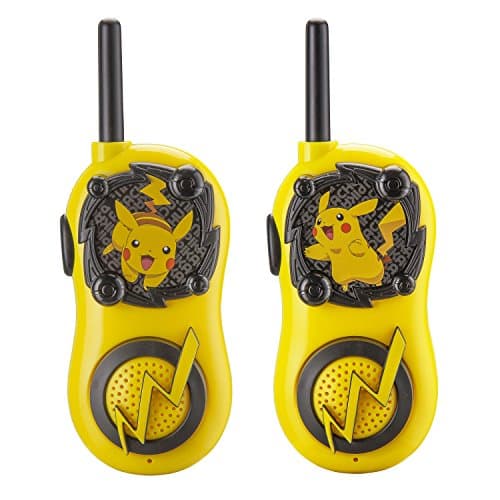 eKids Pokemon Pikachu Toy Walkie Talkies (PK-210, 2-pack) eKids designs the controls for ages 3 and up and advertises up to 500 feet in ideal conditions. Buy it as a toy for the back yard, not as a way of reaching anybody. | Ages 3-4: a toy, and that is fineNo licenseBudget | 4.1/10Researched | $18.99Amazon #ad · Disclosure |
| 2 | 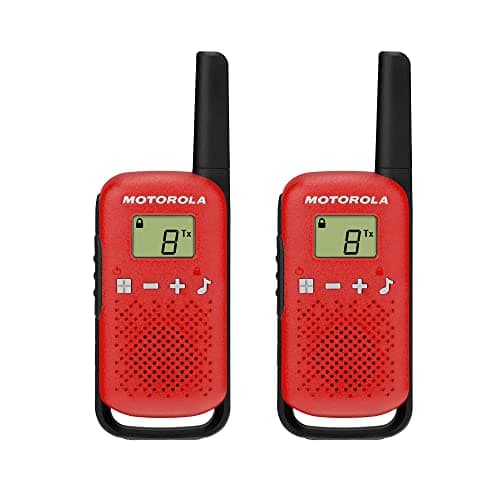 Motorola Talkabout T110 (2-pack) Easy pairing sets every radio to the same channel and code, three AAA cells run up to 19 hours, the keypad locks, and the stickers let a child identify their own radio. | Ages 5-7: the first real radioNo licenseBudget | 4.9/10Researched | $27.49Amazon #ad · Disclosure |
| 3 | No photo Midland X-Talker T31VP (2-pack) 3.76 oz, rechargeable packs plus a AAA fallback, NOAA weather channels, a headphone jack and a keypad lock. The lightest radio here with real features. | Ages 8-10: the light step upNo licenseBudget | 5.4/10Researched | Check price · Amazon #ad · Disclosure |
| 4 | 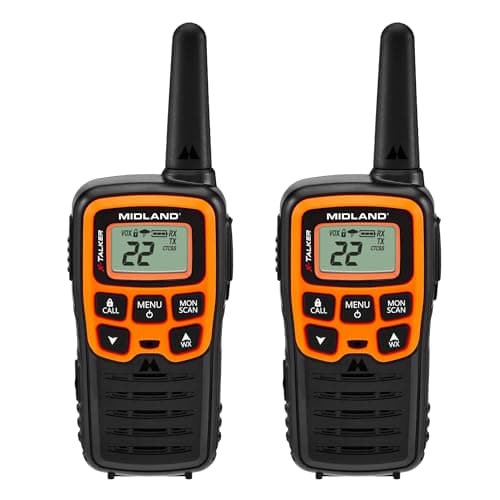 Midland X-Talker T51VP3 (2-pack) NOAA Weather Scan with alert, call alert, eVOX hands-free and a desktop charger. The age at which weather alerts and a charging dock start being used properly. | Ages 11-13: more range, more featuresNo licenseBudget | 5.6/10Researched | $54.99Amazon #ad · Disclosure |
| 5 | 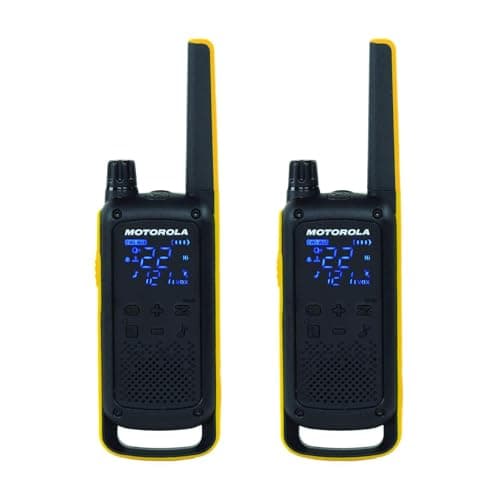 Motorola Talkabout T470 (2-pack) IPX4, up to 28 hours on three AA cells, NOAA alerts, a flashlight, an emergency button, VibraCall vibrate alert and a 2.5 mm headset jack. A radio that outlasts childhood. | Teens and adults: the full-feature radioNo licenseMid-price | 6.1/10Researched | $89.99Amazon #ad · Disclosure |
#ad · Prices come live from Amazon, last checked November 2, 2026. Scores are ours, built from published specs, manuals and FCC rules. Photos come from each product's Amazon listing; a radio we can't show a real photo of is left blank rather than illustrated. Tap a row for the full write-up.
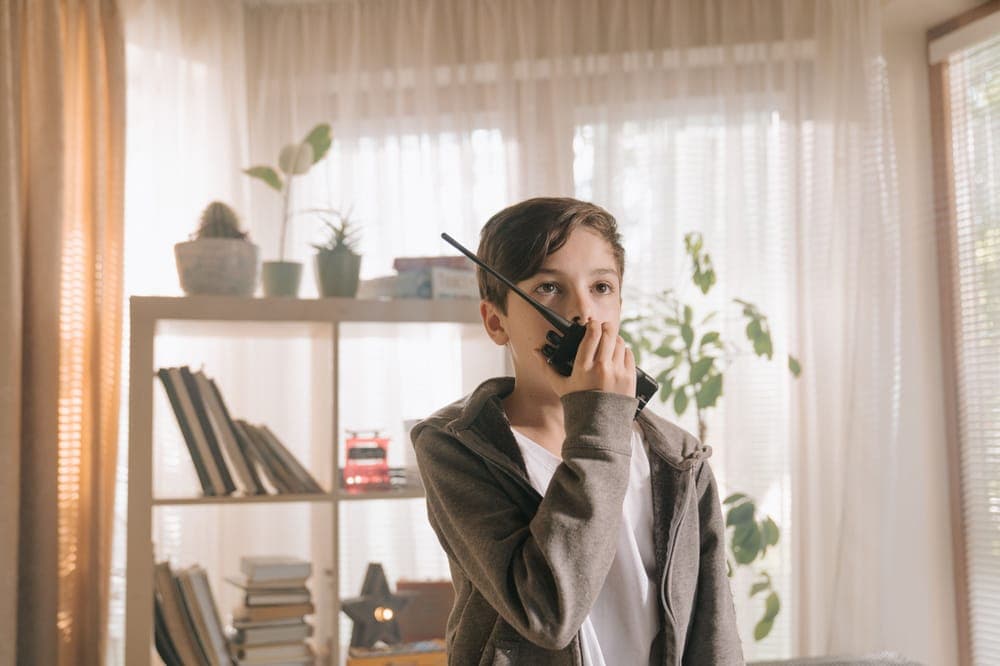
Searching by age is the right instinct, because the specification that matters genuinely changes as children get older — but not in the direction most listings imply. A five-year-old does not need more range; they need a radio that cannot be knocked off channel and that weighs nothing. A twelve-year-old does need range, and will actually use a weather alert and a scan function. The jump between those two is bigger than any price difference.
So this page gives one pick per age band, with the reason the band changes. If you want the whole kids-radio argument rather than the age split, start at best walkie talkies for kids, and toy walkie talkies vs real FRS radios is the page behind the toy-or-real question below.
What actually changes with age
- Ages 3-4: the radio is a toy. The point is pressing a button and hearing a sibling in the next room. Reach is irrelevant; indestructibility and simplicity are everything.
- Ages 5-7: the radio becomes useful, and the failure mode appears. A child this age can call you from the next street — and can also press menu buttons until the radio is on a channel nobody else is on. Easy pairing and a keypad lock are now the key features.
- Ages 8-10: weight and clip quality start deciding everything. A radio that is carried gets used. Under about four ounces is the difference between a radio on a hip and one in a drawer.
- Ages 11-13: features finally get used. Scan, dual watch, NOAA weather alerts and privacy codes stop being clutter. This is also when children range far enough that FRS's real limits start to bite.
- Teens and up: buy the adult radio. Water rating, long battery, headset jack, emergency button. At this point you are buying a radio that will still be in the family in ten years.
How we picked
Every radio is scored on our published rubric: real-world reach, ease of use, toughness and weather, power and battery, field features and value. The method is on how we rank radios, and every figure comes from the maker's own published specification. These are research picks, not test results.
For the younger bands we weighted ease of use and weight hardest and essentially ignored range; for the older bands we let reach and field features back in. Scores are comparable across the whole site, which is why the toy set scores lowest — it is a toy, and that is the correct answer for a four-year-old.
The picks by age band
1. Ages 3-4: eKids Pokemon Pikachu PK-210
A two-player set with controls eKids describes as designed for ages 3 and up, push-button "static free" messages, a Pikachu design, "durable and lightweight material" with no water rating stated, and an advertised range of "up to 500 feet in ideal conditions" (eKids Pokemon walkie talkies page). eKids lists it in its FRS walkie talkies collection, but the product page states no power figure and no channel count.
Buy this with clear eyes: it is a toy, and for a three-year-old a toy is exactly right. Five hundred feet in ideal conditions means house-and-garden, so it works for hide and seek and for a child learning that you have to let go of the button to hear a reply. What it will not do is reach you from a park, which is why the next band exists.
Buy it if the user is three or four and the radio is for play. Skip it if you want to actually reach the child from anywhere: the published figures do not support it.
2. Ages 5-7: Motorola Talkabout T110
Twenty-two channels, easy pairing that sets every radio in the group to the same channel and code, an LCD showing channel, code, low battery, transmit and receive, lock, scan and mute, three AAA alkaline cells rated up to 19 hours, and dual or triple packs with belt clips and personalisation stickers (Motorola Talkabout T110 page). Motorola footnotes the 16-mile headline down to "up to 0.5 miles" in a neighborhood, which is the number to plan around.
This is the first real radio, and the feature set is almost perfectly matched to a five-year-old. Easy pairing plus the keypad lock means a parent sets it up once; the stickers mean a child owns a specific radio; AAA cells from the kitchen drawer mean it works on the day you need it. Half a mile in a neighborhood covers the actual use case: the next street, the park gate, the cul-de-sac.
Buy it if you are replacing a toy with something that genuinely reaches you. Skip it if you need a water rating or rechargeable packs: neither is here, and the cells are not included.
3. Ages 8-10: Midland X-Talker T31VP
3.76 oz per radio, 22 channels and 38 privacy codes, two 300 mAh rechargeable packs plus a three-AAA fallback with a Micro-USB "Y" cable, 10 NOAA weather channels, call alert, eVOX hands-free, a headphone jack and a keypad lock (Midland T31VP page). Midland markets it as its license-free radio for kids and families, and its manual says not to immerse it.
Under four ounces, with rechargeable packs that charge two radios off one cable and alkaline cells as the backup. At eight to ten a child will carry this on a bike, to a friend's house, around a campsite — and the headphone jack starts being used, because this is the age at which a child discovers that a radio can be private-ish rather than broadcast to the whole living room.
Buy it if you want the lightest radio with real features. Skip it if you need a documented water rating: Midland publishes none for it.
4. Ages 11-13: Midland X-Talker T51VP3
Twenty-two channels and 38 privacy codes, NOAA Weather Scan with weather alert radio, call alert, eVOX hands-free, an AVP14 rechargeable pack with a desktop charger and Micro-USB cable in the box, and three-AAA alkaline fallback (Midland T51VP3 page). Midland's "up to 28 miles" claim is footnoted to ideal conditions over water or mountain top to mountain top; the manual says not to immerse the radio.
The step here is the weather alert radio and the dock. An eleven-year-old out on a bike on a summer afternoon is exactly who benefits from a radio that interrupts with a severe weather warning, and a desktop charger is the first charging system a child will actually use without being nagged. It is also the point at which privacy codes become a real tool rather than a confusing menu — our privacy codes page is worth reading together.
Buy it if the child ranges beyond the street and you want weather alerts. Skip it if the radio needs to survive rain and water: there is still no published rating.
5. Teens and adults: Motorola Talkabout T470
IPX4 against splashing water from any direction, 22 channels and 121 privacy codes, an 800 mAh NiMH pack rated up to 12 hours or three AA alkaline cells rated up to 28 hours with a Micro-USB charger included, NOAA weather channels and alerts, an LED flashlight, an emergency button, VibraCall vibrate alert, iVOX and VOX, dual watch and a 2.5 mm headset jack, at 0.30 lb per radio without batteries (Motorola Talkabout T470 page). Its 35-mile claim footnotes to "up to 2 miles" in a neighborhood.
This is where you stop buying children's radios. A teenager will take a radio hiking, skiing, to a festival and on a road trip, and this one survives all four: a splash rating, a 28-hour battery on cells you can buy anywhere, an emergency button and a headset jack. It is also the radio the rest of the family ends up borrowing.
Buy it if you want one radio that outlasts childhood. Skip it if it is for a small child: it is the biggest and busiest radio on this page.
The published specs side by side
In detail
The picks, in full
Rank 01
Ages 3-4: a toy, and that is fine
eKids Pokemon Pikachu Toy Walkie Talkies (PK-210, 2-pack)
eKids designs the controls for ages 3 and up and advertises up to 500 feet in ideal conditions. Buy it as a toy for the back yard, not as a way of reaching anybody.
Published specsResearched · every figure sourced
How the 4.1 score breaks down
- Real-world reach (30%)
- 2
- Ease of use (20%)
- 9
- Toughness & weather (15%)
- 3
- Power & battery (15%)
- 3
- Field features (10%)
- 2
- Value (10%)
- 6
What the specs support
- Made for ages 3 and up, with push-button controls
- Character design kids want to carry
Where it falls short
- eKids claims only up to 500 feet, a fraction of what a real FRS pair is rated for
- No published power, channels, privacy codes, battery or water rating
Skip this if…
…Skip it if you need to reach a child outside the yard or across a campground: eKids' own figure is 500 feet in ideal conditions, so buy a real FRS pair instead.
#ad · Price as of November 2, 2026 · How we make money for the link to eKids Pokemon Pikachu Toy Walkie Talkies (PK-210, 2-pack)
Rank 02
Ages 5-7: the first real radio
Motorola Talkabout T110 (2-pack)
Easy pairing sets every radio to the same channel and code, three AAA cells run up to 19 hours, the keypad locks, and the stickers let a child identify their own radio.
Published specsResearched · every figure sourced
How the 4.9 score breaks down
- Real-world reach (30%)
- 3
- Ease of use (20%)
- 9
- Toughness & weather (15%)
- 3
- Power & battery (15%)
- 5
- Field features (10%)
- 3
- Value (10%)
- 7
What the specs support
- Few buttons and one-step pairing, so a child can run it
- Runs on easy-to-find AAA batteries; stickers help each kid spot their own radio
- Talks to other FRS radios on the same channel and code
Where it falls short
- Batteries are not included and there is no rechargeable option in the box
- No weather rating, NOAA channel or flashlight listed
- Motorola's own neighborhood figure is only up to half a mile
Skip this if…
…Skip it if the kids will be out of sight across a campground or down the block: Motorola's own neighborhood figure is half a mile, and it has no weather rating for rain.
#ad · Price as of November 2, 2026 · How we make money for the link to Motorola Talkabout T110 (2-pack)
Rank 03
Ages 8-10: the light step up
Midland X-Talker T31VP (2-pack)
3.76 oz, rechargeable packs plus a AAA fallback, NOAA weather channels, a headphone jack and a keypad lock. The lightest radio here with real features.
Published specsResearched · every figure sourced
How the 5.4 score breaks down
- Real-world reach (30%)
- 3
- Ease of use (20%)
- 9
- Toughness & weather (15%)
- 4
- Power & battery (15%)
- 5
- Field features (10%)
- 6
- Value (10%)
- 7
What the specs support
- Marketed by Midland for kids, with a compact body for small hands
- Rechargeable packs included, with AAA batteries as a backup
- Weather alerts, call alert and hands-free eVOX
Where it falls short
- 300 mAh packs are small; Midland publishes no runtime figure
- The manual says not to immerse it in water
Skip this if…
…Skip it if the radios are for adults hiking separate trails: it's sized for backyard and neighborhood play, and the packs are small.
#ad · Price as of November 2, 2026 · How we make money for the link to Midland X-Talker T31VP (2-pack)
Rank 04
Ages 11-13: more range, more features
Midland X-Talker T51VP3 (2-pack)
NOAA Weather Scan with alert, call alert, eVOX hands-free and a desktop charger. The age at which weather alerts and a charging dock start being used properly.
Published specsResearched · every figure sourced
How the 5.6 score breaks down
- Real-world reach (30%)
- 4
- Ease of use (20%)
- 8
- Toughness & weather (15%)
- 3
- Power & battery (15%)
- 6
- Field features (10%)
- 6
- Value (10%)
- 8
What the specs support
- NOAA Weather Scan and weather alerts for storms on camping trips
- Rechargeable packs plus a desktop charger, with AAA backup
- License-free and simple enough for the whole family
Where it falls short
- No water rating, and the manual warns against immersion
- No runtime figure published
Skip this if…
…Skip it if it will ride in a kayak or a wet pack: Midland gives it no water rating, so choose an IP67 radio instead.
#ad · Price as of November 2, 2026 · How we make money for the link to Midland X-Talker T51VP3 (2-pack)
Rank 05
Teens and adults: the full-feature radio
Motorola Talkabout T470 (2-pack)
IPX4, up to 28 hours on three AA cells, NOAA alerts, a flashlight, an emergency button, VibraCall vibrate alert and a 2.5 mm headset jack. A radio that outlasts childhood.
Published specsResearched · every figure sourced
How the 6.1 score breaks down
- Real-world reach (30%)
- 4
- Ease of use (20%)
- 8
- Toughness & weather (15%)
- 5
- Power & battery (15%)
- 7
- Field features (10%)
- 8
- Value (10%)
- 7
What the specs support
- AA fallback with a stated 28 hours, which suits an emergency kit
- NOAA alerts, flashlight and emergency button included
- Hands-free iVOX/VOX and a standard 2.5 mm headset jack
Where it falls short
- Micro-USB charging, not USB-C
- IPX4 is splash protection only; don't drop it in water
- Motorola doesn't publish the transmit power
Skip this if…
…Skip it if it will get wet often: IPX4 handles rain, not a creek crossing or a canoe, so the IP67 T605 is the Motorola to buy.
#ad · Price as of November 2, 2026 · How we make money for the link to Motorola Talkabout T470 (2-pack)
When a toy stops being enough
The cleanest dividing line is the one the makers draw themselves. A toy set like the eKids pair publishes no transmit power and no channel count, and advertises 500 feet in ideal conditions. A real FRS radio publishes its channels, its codes and its battery figures, and the service it runs on is defined in federal rules. If a listing will not tell you its channel count, treat the range figure as decoration.
Three signs it is time to move up:
- The child goes somewhere you cannot see. The next street, the park, a campsite loop. Five hundred feet does not cover it; half a mile does.
- They want to talk to somebody else's radio. Toy sets are often a closed pair. Real FRS radios share 22 standard channels, so a friend's radio works with yours.
- Batteries are now the main complaint. A radio with rechargeable packs and a dock, or with AA cells rated in the tens of hours, ends that conversation.
Full argument, with the physics and the FCC rules, on toy walkie talkies vs real FRS radios.
Licenses, codes and what to teach
Three things worth teaching at any age, in this order:
- Press, pause, talk, release. The single most common reason a child's message does not arrive is that they started talking before the button went down, or never let it up.
- Anyone can hear you. Privacy codes are not privacy - they only control what your own radio unmutes for. No names, no addresses, nothing you would not say out loud in a queue.
- What to do when it does not work. A radio fails inside buildings and over hills. The meeting point and the phone number are the plan; the radio is a convenience on top of it.
What to look for at any age
- A keypad lock. The one feature that prevents the one failure that actually happens.
- Weight before range. Under five ounces for a child, under four if you can.
- A battery you can replace in the field. AAA or AA cells beat a sealed pack for anyone under about twelve.
- Twenty-two standard FRS channels, so a friend's radio works with yours.
- Something that distinguishes each radio - stickers, colors or tape with a name on it.
- NOAA weather alerts from about eleven, when a child is out far enough for it to matter.
- A published water rating for teenagers, who will take the radio somewhere wet.
How we scored this
Every pick here is backed by the paperwork
Every pick is labeled Researched: we read each maker's published specs, manuals and range tables, check the license rules against the FCC, and score every radio on a public rubric out of 10. Every figure links to where it came from, and every range number is labeled “advertised” so you can see the difference between the box and the terrain.
Scores are our editorial judgment on that documented evidence. Commissions never set a score or decide a pick. The rubric and its weights are published.
What changed
- Published.
Questions
Frequently asked
What age are walkie talkies suitable for?
What is the best walkie talkie for a 5 year old?
What is the best walkie talkie for a 10 year old?
Do children need a license to use a walkie talkie?
Are toy walkie talkies worth buying?
Receipts
Sources
- eKids: Pokemon Pikachu toy walkie talkies product page (checked 2026-10-11)
- Motorola: Talkabout T110 series product page (checked 2026-10-11)
- Motorola: Talkabout T470 series product page (checked 2026-10-11)
- Midland: X-Talker T31VP product page (checked 2026-10-11)
- Midland: X-Talker T51VP3 product page (checked 2026-10-11)
- FCC: Family Radio Service (FRS) page (checked 2026-10-11)
- 47 CFR 95.531, FRS channel power limits (via Cornell LII, checked 2026-10-11)
Specs and range figures come from each maker's own pages and manuals, linked on every product, and license, power and channel rules come from the FCC and 47 CFR Part 95. Range numbers are the maker's advertised claims and are labeled that way, so you can tell the box number from the terrain number. Prices come live from Amazon with the time we checked. Read the full method.